Payday comes and the money disappears
By the 15th it's gone, and you can't say where it went.

A 7-tab spreadsheet and an illustrated PDF guide to decide, on payday, where each part of your money goes.

 Nina explains each step
Real screens from the kit, in Portuguese
Leave your email and Nina will let you know when the kit can be bought outside Brazil. Meanwhile, grab the free Adult First Aid Kit (in Portuguese).
We'll only use your email to let you know when sales open. Privacy policy.
Get the free kitBy the 15th it's gone, and you can't say where it went.
Utilities, water, power and internet showed up too, and the math didn't work.
A subscription here, a delivery there, and by the end of the month nobody knows how much it was.
It's not your fault. When nobody tells the money where to go on the 1st, it disappears by the 15th without warning. The kit exists so you can give it that destination.
You open your statement for the last 30 days and write everything down, without judgment. That is how you see where the money is leaking.
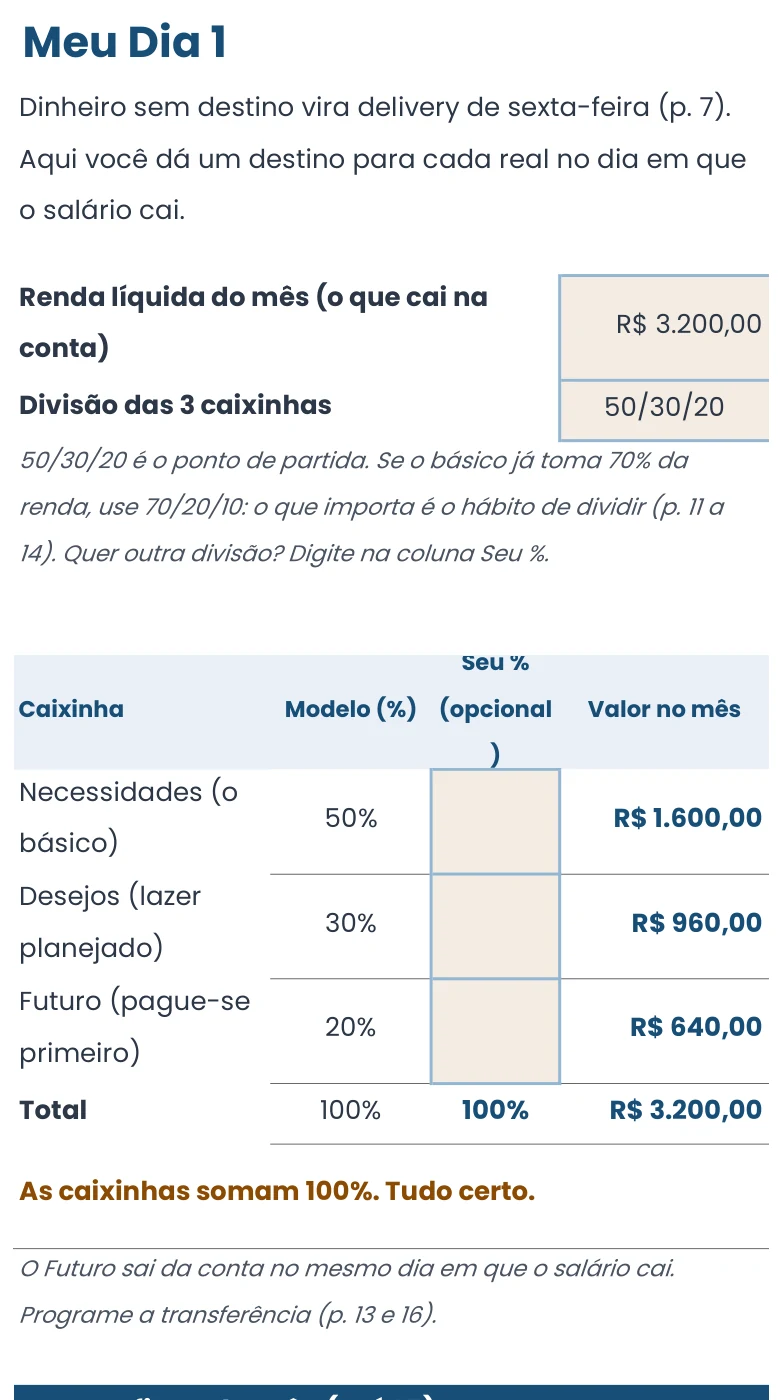
Needs, wants and future. The starting split is 50/30/20; if the basics weigh more, you adjust to 70/20/10. Planned fun is part of the math, and the future part goes out on the same day your paycheck lands.
Your emergency savings. It starts with the goal of saving 1 month of bills and gets a transfer every payday.
In Google Sheets (you make your own copy) or as an .xlsx file for Excel or LibreOffice. You fill it in; it does the math.
Nina walks you through it in four chapters: the reality check of living alone, the 50/30/20 rule, the invisible drain of small expenses and the peace-of-mind fund. At the end, your next steps, day by day.
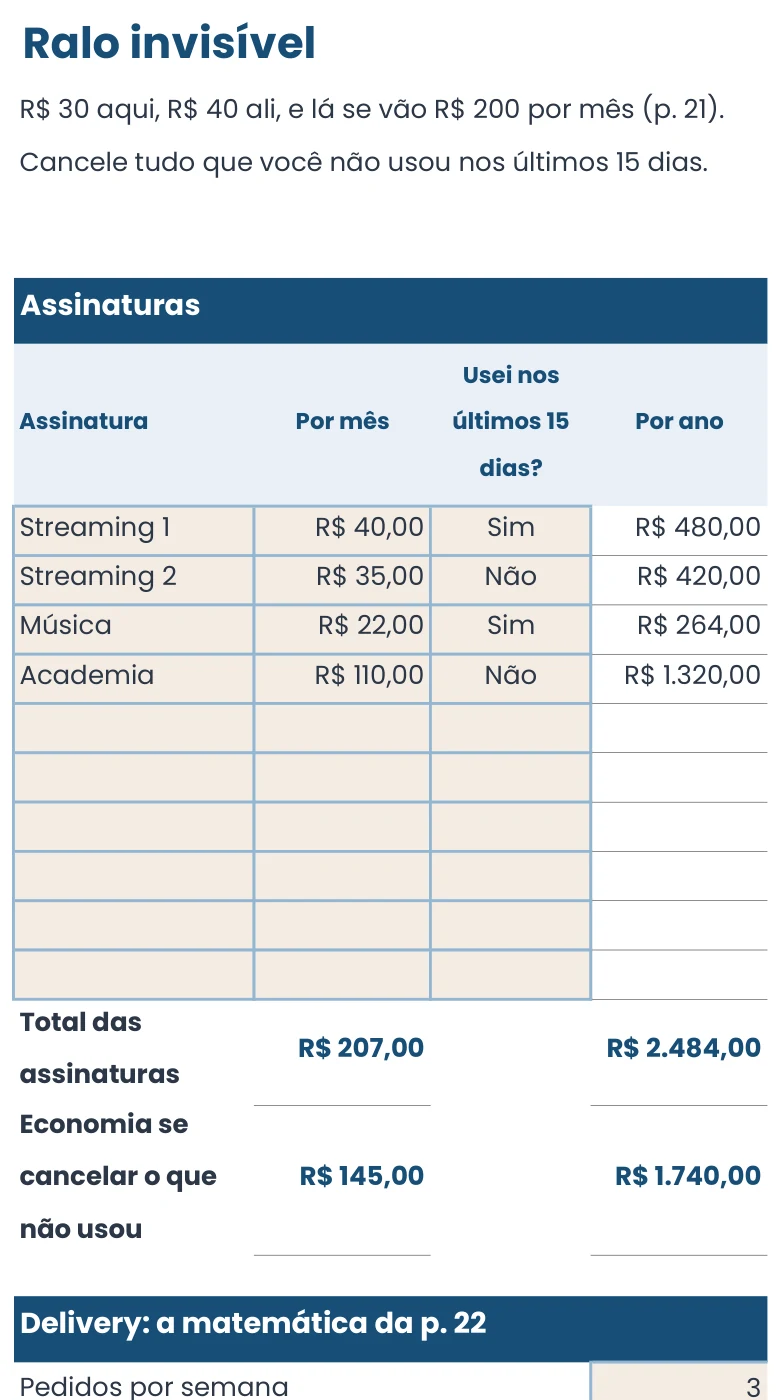
Real pages from the guide and screens from the spreadsheet, filled in with an example. In Portuguese.



These are the 5 steps in the spreadsheet's Start here tab. Each tab points to the guide page the rule came from.
Open your statement for the last 30 days and write everything down, without judgment. For each expense, pick the bucket: need, want or future.
Enter your take-home pay, choose the split (50/30/20 or 70/20/10) and list your fixed bills. The spreadsheet warns you when housing goes over 30% of your income.
List your subscriptions and mark the ones you haven't used in the last 15 days. Do the math on delivery and ride apps.
Start from the goal of 1 month of essential bills and see how many months it takes to get there.
Write down the bills that only come once a year. Then follow the 30-day plan and check off what you have done.
Nina is the SobreVivendo Adulto character. In the guide, she explains each step with everyday examples, the way a friend would. The spreadsheet does the math; you make the decisions.
Educational material. It does not replace professional financial advice.
Not yet. The spreadsheet and the guide are in Portuguese. This page is in English so you know what's inside. If you join the list, Nina will let you know when sales open outside Brazil.
Not from outside Brazil yet. That's why this page has a waitlist instead of a buy button. Joining the list is free and doesn't commit you to anything.
The kit was made in Brazil, so the examples use Brazilian reais (R$). The method itself (X-ray, 3 buckets, peace-of-mind fund) works with any currency: you type in your own numbers.
Yes. The spreadsheet was built to fit on a phone screen and opens in the free Google Sheets app. The guide is a PDF that opens on any phone. For filling it in the first time, a computer is more comfortable, but not required.
No. You make a copy of the spreadsheet in Google Sheets, which is free and only needs a Google account. If you prefer Excel or LibreOffice, the kit also includes the .xlsx file.
It's free: five SOS cards, a checklist and a wallpaper, ready to download. In Portuguese for now.